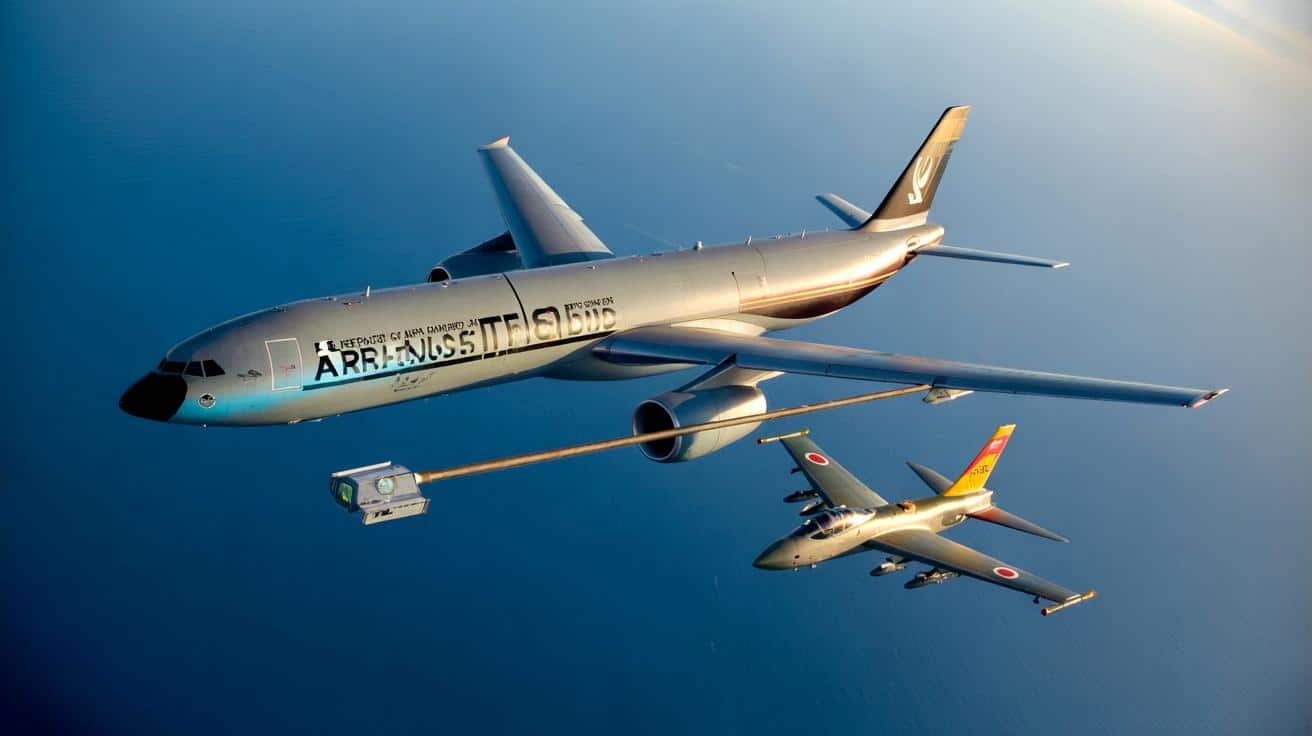
On 4 February 2026, Singapore became the first country to field a fully certified automatic air‑to‑air refuelling capability, giving Airbus a visible edge over Boeing in a niche that carries huge military and commercial stakes.
Singapore and Airbus make aviation history
Airbus and the Republic of Singapore Air Force (RSAF) have secured the world’s first certification for an automatic in‑flight refuelling system, known as A3R – Automatic Air‑to‑Air Refuelling.
The system equips Singapore’s A330 MRTT (Multi Role Tanker Transport) fleet, turning it into the first operational tanker force officially cleared to refuel other aircraft with the boom controlled by software rather than the operator’s hands.
A3R steers, aligns and connects the refuelling boom automatically, while a human operator watches and can intervene at any moment.
Traditional boom refuelling is one of the most demanding manoeuvres in military aviation. Two jets fly a few metres apart at around 800 km/h, sometimes at night or through turbulence. A boom operator sits at a console, guiding a long, telescopic boom into the receiving aircraft with millimetric precision. One bad move can damage both aircraft.
With A3R, sensors and algorithms take over the hardest part of that work. Smart cameras feed data into onboard image‑processing software and guidance logic. The system calculates the relative motion of the receiver aircraft, stabilises the boom and performs the final plug‑in automatically. The operator monitors the sequence and can override the system instantly if anything looks wrong.
How the automatic refuelling system actually works
From manual skill to assisted intelligence
Instead of peering through a window or a 2D camera feed and making tiny joystick movements, the boom operator now supervises automation. The A3R suite combines:
- High‑resolution day and night cameras with depth perception
- Image‑processing software that tracks the receiver aircraft in real time
- Guidance algorithms that predict motion and correct the boom trajectory
- Safety logic that aborts the connection if aircraft move out of tolerance
This shift changes the operator’s role from “manual pilot of the boom” to “mission manager” who oversees the operation, handles communications and focuses on tactical decisions instead of micromovements.
The goal is not to remove humans from the cockpit, but to remove fatigue and human error from a risky, repetitive task.
➡️ Diese Gewohnheit sorgt dafür, dass Aufgaben nicht mehr liegen bleiben
➡️ Immer mehr Menschen setzen auf den Alufolien‑Trick an Türklinken: darum
➡️ Warum Füße in der Wohnung kalt werden, obwohl es warm ist
Automation also enables more consistent performance. A human boom operator can be excellent on a good day and struggle in strong turbulence or after long missions. A validated algorithm behaves predictably from one flight to the next, which matters for planning complex air campaigns.
A fast‑tracked partnership since 2020
A3R forms part of Airbus’s broader “SMART MRTT” programme, aimed at turning the A330 MRTT into a more connected, data‑driven platform. Singapore stepped in as a core partner in 2020, providing aircraft, crews and engineers for intensive trials.
The RSAF made its A330 MRTT tankers, along with F‑15 and F‑16 fighters, available for repetitive test campaigns. Engineers from Airbus worked alongside Singapore’s Defence Science and Technology Agency (DSTA), adjusting software parameters flight after flight.
Early testing took place in Spain, where Airbus has long used its Getafe site as a tanker conversion and trials hub. Later phases moved to Singapore’s tropical environment, bringing new variables such as heavy rain, dense cloud layers and different lighting conditions. The Spanish aerospace technology institute INTA eventually validated the system, clearing the way for formal certification.
Boeing’s KC‑46A Pegasus struggles to keep up
Semi‑automatic versus fully automatic
Across the Atlantic, Boeing’s KC‑46A Pegasus is Airbus’s main rival in the tanker business. The Pegasus already uses cameras and a remote console under a system branded ARO (Automatic Boom Operator). The name sounds similar, but the philosophy differs.
On the KC‑46A, refuelling remains fully manual. The operator sits at a remote vision station, watching 3D video and moving the boom using controls. The software helps with stability, yet it does not execute the final alignment and connection by itself. Every contact still depends on human skill at that moment.
US Air Force reports and audit documents have repeatedly flagged issues with this design. Operators sometimes see a distorted image, especially when the sun sits low or the receiver aircraft reflects light in odd ways. In some lighting conditions, judging depth becomes difficult, which risks scraping paint or worse.
- 3D vision that can blur or mislead under challenging lighting
- Restrictions on refuelling some lighter aircraft types
- Long programme delays and redesigns
- No certified automatic refuelling capability so far
The US Air Force has funded a major upgrade, known as RVS 2.0, intended to fix the vision problems. That retrofit is not expected to be fielded across the fleet before late 2025 at best, and it does not instantly convert the system into a fully automatic one.
While Boeing reworks its semi‑automatic vision system, Airbus now holds the only certified end‑to‑end automatic refuelling solution on an operational tanker.
How the A330 MRTT and KC‑46A compare
Beyond the A3R story, the two tankers differ on several fundamentals that shape export prospects and military planning.
| Criterion | Airbus A330 MRTT | Boeing KC‑46A Pegasus |
| Base airframe | Airbus A330‑200 | Boeing 767‑2C |
| Fuel capacity (approx.) | ≈ 111 tonnes in wings and tanks | ≈ 96 tonnes |
| Maximum troop seats | Around 260 seats | Lower, smaller cabin |
| Main role | Multirole tanker and strategic transport | Tanker for USAF with transport capability |
| Customer base | More than 15 countries over three continents | Mainly United States plus a few others |
| Orders (approx.) | About 75 aircraft | About 150, largely for USAF |
| Deliveries (approx.) | More than 60 delivered | Dozens in service |
| Key advantage | High fuel and passenger capacity, export‑oriented | Deep integration in US logistics and doctrine |
The A330 MRTT offers more fuel and cabin space, making it attractive for countries that want one aircraft for tanker, troop transport and medical evacuation roles. The KC‑46A, by contrast, fits tightly into US infrastructure and procedures, which suits Washington and close allies that buy into the wider US system.
Why automatic refuelling matters for future conflicts
Operational benefits beyond the tech buzz
Automatic refuelling might sound like a niche upgrade, yet it has concrete consequences for air forces planning long‑range operations. Fewer demands on the boom operator mean longer missions with less crew fatigue. That matters during sustained air campaigns where tankers may orbit for hours and refuel dozens of jets in a single sortie.
Automation can also increase sortie efficiency. If refuelling cycles run faster and with fewer aborted contacts, fighters spend less time waiting in queues behind the tanker and more time on task over their targets or patrol zones. Over days of combat, those minutes add up.
Training pipelines could shorten as well. Teaching someone to monitor a system and manage procedures typically takes less time than training a specialist to fly a boom manually in every possible weather and lighting condition. For smaller air forces with limited personnel, that difference matters.
In a scenario where one tanker supports mixed formations of fighters, bombers and surveillance aircraft, automatic contacts can shave precious minutes off each cycle.
Risks, safeguards and what could go wrong
Automation does introduce new questions. What happens if a sensor fails mid‑approach? What if the tracking algorithm misidentifies a glint of sunlight as part of the receiver’s structure? Airbus and its military partners address those concerns with layers of safety rules and human authority.
The A3R system is designed so that the operator retains a physical override. If the aircraft move outside defined safety envelopes, the automation disengages and the boom retracts. Strict certification trials test faults such as lost camera feed, corrupted data or sudden manoeuvres by the receiving aircraft.
Yet no system reaches zero risk. Defence planners will watch how A3R behaves over thousands of operational hours, not just during scripted trials. Incident reports from early adopter fleets like Singapore’s will heavily influence whether other countries trust similar automation for their own tanker fleets.
What this means for the global tanker market
For Airbus, Singapore’s certification does more than tick a technical box. It creates a showcase. Air forces shopping for a new tanker or planning mid‑life upgrades will look at who can offer a proven automatic system backed by an operational user, not just a brochure concept.
Countries in Europe, the Middle East and the Asia‑Pacific region are already planning replacements for ageing KC‑135s and other legacy tankers. Automatic refuelling now becomes a point on their requirements checklist, alongside fuel offload, range and cost. A3R gives Airbus a headline feature it can attach to wider “smart tanker” packages such as networked operations and data‑sharing with fighter fleets.
For Boeing, the move raises the pressure to stabilise the KC‑46A programme and outline a credible path toward more automation once its vision system upgrade is complete. The Pegasus still benefits from strong US political backing and a large guaranteed domestic order book, yet export campaigns may face tougher questions from governments that have seen Singapore’s experience with A3R.
Key terms and scenarios worth understanding
Two terms often confuse non‑specialists: “boom” and “probe‑and‑drogue”. A boom is a rigid telescopic tube controlled from the tanker, used mainly by US‑designed aircraft. Probe‑and‑drogue uses a flexible hose with a basket at the end, which receiver aircraft hook into using a fixed probe. The A330 MRTT can use both systems, while A3R focuses on automating boom operations.
Imagine a crisis in the Pacific where allied fighters need to patrol thousands of kilometres from their bases. Tankers orbit in pre‑planned tracks, refuelling mixed groups of jets, patrol aircraft and perhaps drones. In that setting, automatic refuelling can keep cycles predictable, support more aircraft per tanker and reduce the cognitive load on small crews managing complex airspaces.
Another scenario involves future unmanned combat aircraft. Refuelling drones in flight with a manually flown boom would place heavy strain on human operators trying to judge closure rates and alignment with a pilotless receiver. Automated logic that can talk directly to a drone’s flight controls, using shared data links, looks far more scalable. The A3R certification with a manned receiver is only a first step along that path.