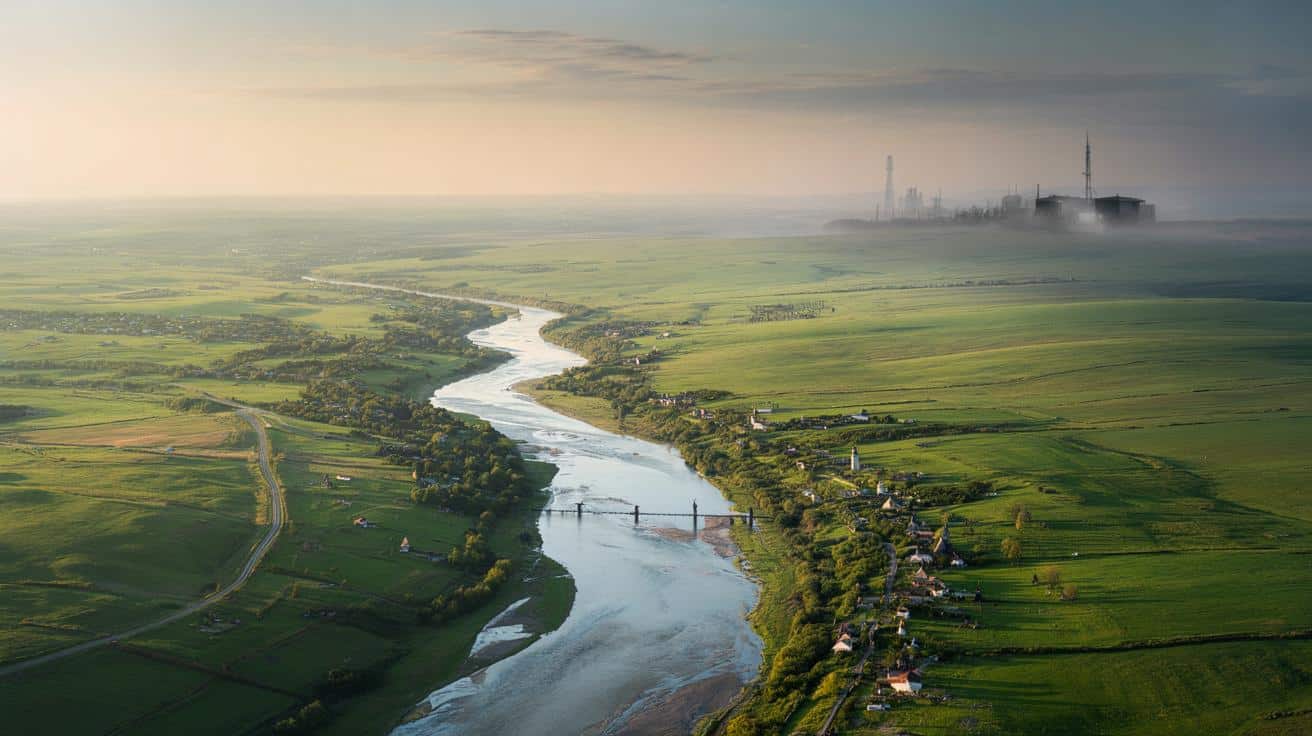
Across the Prut River, where Moldova meets Romania, old borders and older fears are resurfacing. War in Ukraine, Russian troops in a breakaway Moldovan region and a race towards the European Union have pushed two closely linked countries to ask a blunt question: should they become one again?
History that refuses to stay in the past
Before the Soviet era, today’s Republic of Moldova and Romania were not as distinct as their modern passports suggest. In 1859, the principalities of Moldavia and Wallachia united, forming the core of what would become Romania. After the First World War, Bessarabia – roughly corresponding to present-day central and eastern Moldova – joined the Romanian kingdom, helping create what Romanians still call “Greater Romania”.
That experience ended abruptly in 1940. Under the Molotov–Ribbentrop Pact, Nazi Germany and the Soviet Union carved up Eastern Europe. The USSR annexed Bessarabia and created the Moldavian Soviet Socialist Republic. Romanian elites, culture and symbols came under systematic pressure.
For nearly fifty years, Moscow tried to recast Moldovan identity as something distinct from, and even opposed to, Romanian identity. The Cyrillic alphabet was imposed for the Romanian language. Cross-border cultural contacts along the Prut were restricted. Romanian-speaking intellectuals faced deportation to Siberia. Large numbers of Russian and Ukrainian settlers were encouraged to move in.
This Soviet-era social engineering is described by some historians as a form of “cultural genocide” aimed at erasing the Romanian character of the region.
When the Soviet Union collapsed in 1991, Moldova became independent. But the country emerged with a split identity and a deep strategic dilemma: look west to Romania and the EU, or accept continued entanglement with Russia?
A small country wedged between two power blocs
Three decades later, Moldova is still caught in that vice. Romania is now an EU and NATO member, offering a clear route into Western institutions. Russia, by contrast, maintains a small but symbolically powerful military presence on Moldovan soil: roughly 1,500 troops in Transnistria, a pro-Moscow separatist enclave on the country’s eastern edge.
Chisinau and Western governments describe that deployment as illegal. Moscow calls it a peacekeeping mission. On the ground, it functions as a lever of pressure. Transnistria’s unresolved status limits Moldova’s freedom of movement, especially in security policy.
In recent months, the tension has sharpened. Moldovan and Western officials accuse Russia of pumping around €350 million – a huge sum for a country with a tiny GDP – into political operations, disinformation and influence campaigns ahead of the 2025 parliamentary elections. The goal, they say, is to keep Moldova weak, divided and outside the Western orbit.
➡️ Diese unterschätzte Routine sorgt für mehr Ruhe im Alltag
➡️ Fünf von zehn Gärtnern düngen ihre Obstbäume falsch wegen eines sehr häufigen Fehlers
➡️ Diese unterschätzte Einstellung im Router macht dein WLAN schneller, ohne neues Gerät
➡️ Kein Natron, kein Essig: Dieser Trick macht die Gummidichtung der Waschmaschine wie neu
➡️ Queues grow at Lidl for this 3‑in‑1 vacuum cleaner
➡️ Was bedeutet es psychologisch, wenn jemand seinen Namen in der Unterschrift unterstreicht
➡️ Diese einfache Methode verhindert, dass Aufgaben liegen bleiben
The Kremlin does not need tanks to shape Moldovan politics; money, media influence and frozen conflicts can achieve a lot on their own.
Talk of reunification moves from taboo to real option
Against that backdrop, an idea once pushed to the margins has returned to the mainstream: reunification with Romania. It is not yet a formal government plan. There is no roadmap, no white paper. But it is no longer taboo.
On 27 January, Moldovan President Maia Sandu visited Poland. Asked what she would do in a hypothetical referendum on unification with Romania, she answered simply: she would vote “yes”. She stressed it was a personal view, not an official policy. Even so, her words landed with force.
In Bucharest, the response was swift and supportive. Romania’s prime minister, Ilie Bolojan, said that if a similar referendum were held on his side of the border, he would also vote in favour. His message was that any such union, if it ever happened, would be a logical extension of Moldova’s European ambitions.
For pro-union voices, Romania is not just a neighbour but a shortcut: a direct lane into the EU’s legal, economic and security umbrella.
Public opinion: two societies, two moods
The politics are delicate because Moldovan public opinion is far from united. Recent polling suggests:
- Roughly one third of Moldovans support reunification with Romania.
- A majority are either opposed or undecided.
- About 60% support EU membership for Moldova as an independent state.
- In Romania, around 56% favour a possible union with Moldova.
The split in Moldova follows generational and ideological lines. Younger urban voters tend to see their future in the European Union. Older citizens who lived most of their lives under Soviet rule often retain stronger cultural and informational ties to Russia, and greater scepticism towards NATO and the West.
Why the EU path still comes first
Despite the new attention around reunification, Sandu’s stated priority remains clear: full EU membership for Moldova. In her view, the EU offers the most credible guarantee of security, democracy and civil freedoms.
Moldova formally applied for EU membership in 2022, shortly after Russia’s full-scale invasion of Ukraine. Brussels granted candidate status, sending a strong signal of support, but accession is a long process. Chisinau must tackle entrenched corruption, reform its justice system and stabilise its economy.
For many Moldovans, EU membership without changing the country’s borders feels less disruptive and less emotionally charged than unification. It promises access to jobs, investment and the single market while keeping Moldova’s statehood intact.
Between the blue flag with yellow stars and the idea of a single Romanian state, Moldovan voters currently lean more towards Brussels than towards a new national union.
What reunification would change on the map
Even as a remote scenario, Moldovan–Romanian reunification carries huge geopolitical consequences. If Moldova joined Romania, it would effectively become part of both the EU and NATO overnight, through Romania’s existing memberships.
That shift would place a Western security blanket over territory that Moscow still sees as part of its historic sphere of influence. It would also raise difficult questions about Transnistria, where Russian troops are stationed just a few hundred kilometres from the Ukrainian port of Odesa.
From Russia’s perspective, any move that locks Moldova into Western structures is a loss. Whether through EU membership alone or through a full state union, Moscow would eventually face stronger pressure to withdraw forces from Transnistria.
| Scenario | Status of Moldova | Impact on Russia |
|---|---|---|
| Stay non-aligned | Independent, outside EU and NATO | Maintains leverage via energy, media and Transnistria |
| EU membership only | Independent, inside EU but outside NATO (at least initially) | Economic and political influence reduced; pressure on troops in Transnistria grows |
| Reunification with Romania | Part of Romania, thus in both EU and NATO | Major strategic setback; Western security architecture expands to Russia’s doorstep |
Why this matters beyond Eastern Europe
The debate over Moldova and Romania is more than a local border question. It tests how far Europe is willing to go to secure small, vulnerable states under pressure from Moscow. It also revives a sensitive issue: can borders in Europe still change peacefully, by mutual consent and democratic choice?
For the EU and NATO, Moldovan reunification would create both opportunities and headaches. On one hand, it would simplify integration: instead of negotiating complex accession chapters with a fragile state, Brussels would deal with an expanded Romania. On the other, it would draw the Western alliance deeper into a zone where Russian troops and unresolved conflicts remain on the ground.
Key terms and fault lines explained
Two concepts help frame what is at stake:
- “Frozen conflict”: a war that has stopped without a full political settlement, leaving armed groups and outside powers in place. Transnistria is a textbook case, allowing Russia to influence Moldovan decisions without direct occupation.
- “Sphere of influence”: a region where a big power expects deference from smaller neighbours. The EU’s push east and Russia’s efforts to block it collide squarely in Moldova.
In practice, these dynamics affect daily life. Energy prices, media narratives, migration routes and job prospects are all tied to which camp Moldova leans towards. Romanian citizenship has already become a quiet outlet: many Moldovans with Romanian roots have obtained Romanian passports, working and studying across the EU while their country still waits outside.
Possible futures: from gradual integration to sudden change
Several paths remain on the table. One involves gradual, sector-by-sector integration with Romania: shared infrastructure projects, joint energy grids, coordinated education reforms and easier cross-border work rules. This approach deepens links without a formal union, and could soften resistance inside Moldova.
Another scenario is a sharp break triggered by crisis. A major security shock, such as escalating Russian pressure on Transnistria or renewed destabilisation attempts around elections, could push Moldovan leaders and voters to move faster towards Romania and Western protection.
There is also the risk of backlash. Strong pro-Russian parties, amplified by Kremlin-linked media, could use reunification talk to fuel fear campaigns, especially in Russian-speaking communities in Moldova. That could raise tensions on the streets and in parliament, complicating both EU reforms and relations with Bucharest.
For now, the conversation itself is reshaping the region’s mental map. A proposal long confined to nationalist circles is now being discussed in presidential interviews and prime ministerial statements. Whether Moldova chooses EU membership as an independent state, a shared flag with Romania, or some hybrid route in between, Russian influence is no longer the only game in town.